variation
variation
gallery
gallery

🔬 Research Use Only

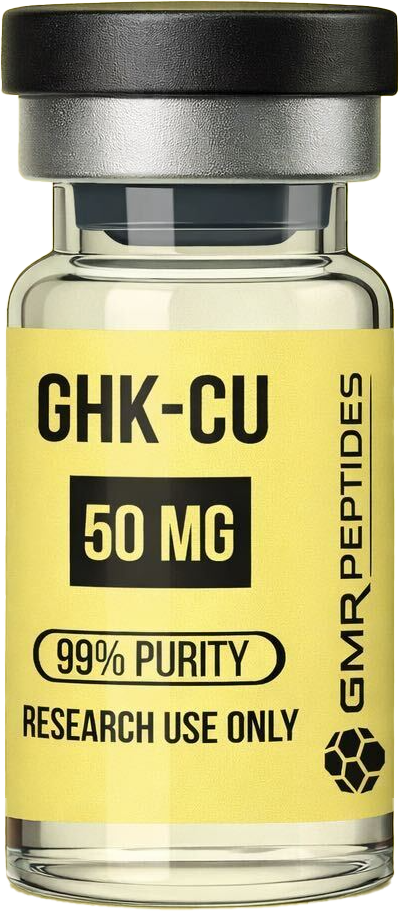
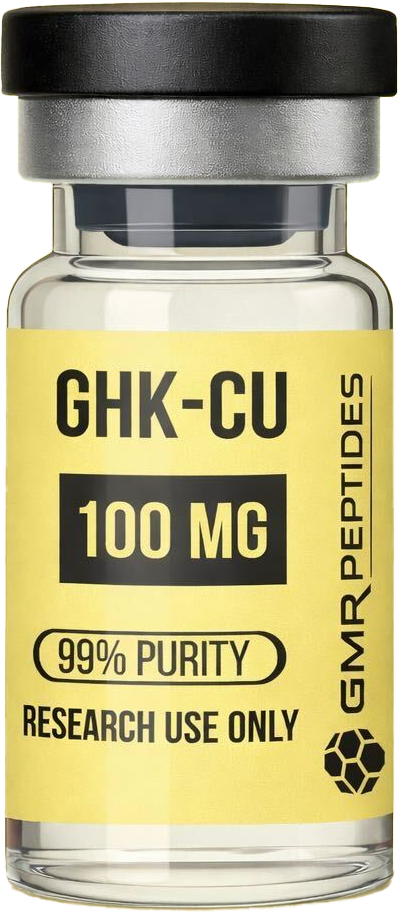
GHK-Cu Research Peptide

Longevity Research · Recovery Research · Skin & Anti-Aging Research

GHK-Cu research peptide is a copper-binding tripeptide supplied as a lyophilized research compound for laboratory investigations involving peptide signaling, copper transport mechanisms, and extracellular matrix research models.

Select Dosage

Bundle & Save

1 bottle

1 bottle

2 bottle

3.29% OFF
2 bottle

3 bottle

5% OFF
3 bottle
Bundle & Save

1 bottle

$39.99

2 bottle

Save 3.29%

3 bottle

Save 5%
$39.99

110 in stock

. ships today if ordered before 3pm ET

per 50mg vial

SSL 256-bit

Secure Checkout

Free shipping

On orders over $200

60-day returns

Money-back guarantee

🚚 Get 2 day shipping when you spend $250 or More

🚚 Free shipping over $200

🔄 60-day money back

🔒 SSL Secure

📦 Discreet packaging

We Accept

variation
variation
gallery
gallery

🔬 Research Use Only

GHK-Cu Research Peptide

Longevity Research · Recovery Research · Skin & Anti-Aging Research

GHK-Cu research peptide is a copper-binding tripeptide supplied as a lyophilized research compound for laboratory investigations involving peptide signaling, copper transport mechanisms, and extracellular matrix research models.

Select Dosage

Bundle & Save

1 bottle

1 bottle

2 bottle

3.29% OFF
2 bottle

3 bottle

5% OFF
3 bottle
$39.99

🚚 Get 2 day shipping when you spend $250 or More

🚚 Free shipping over $200

🔄 60-day money back

🔒 SSL Secure

📦 Discreet packaging

We Accept

99%+ Purity Guaranteed

Every batch verified by accredited US labs

Shipment Protection

Every order fully covered

60-Day Money Back

No questions asked

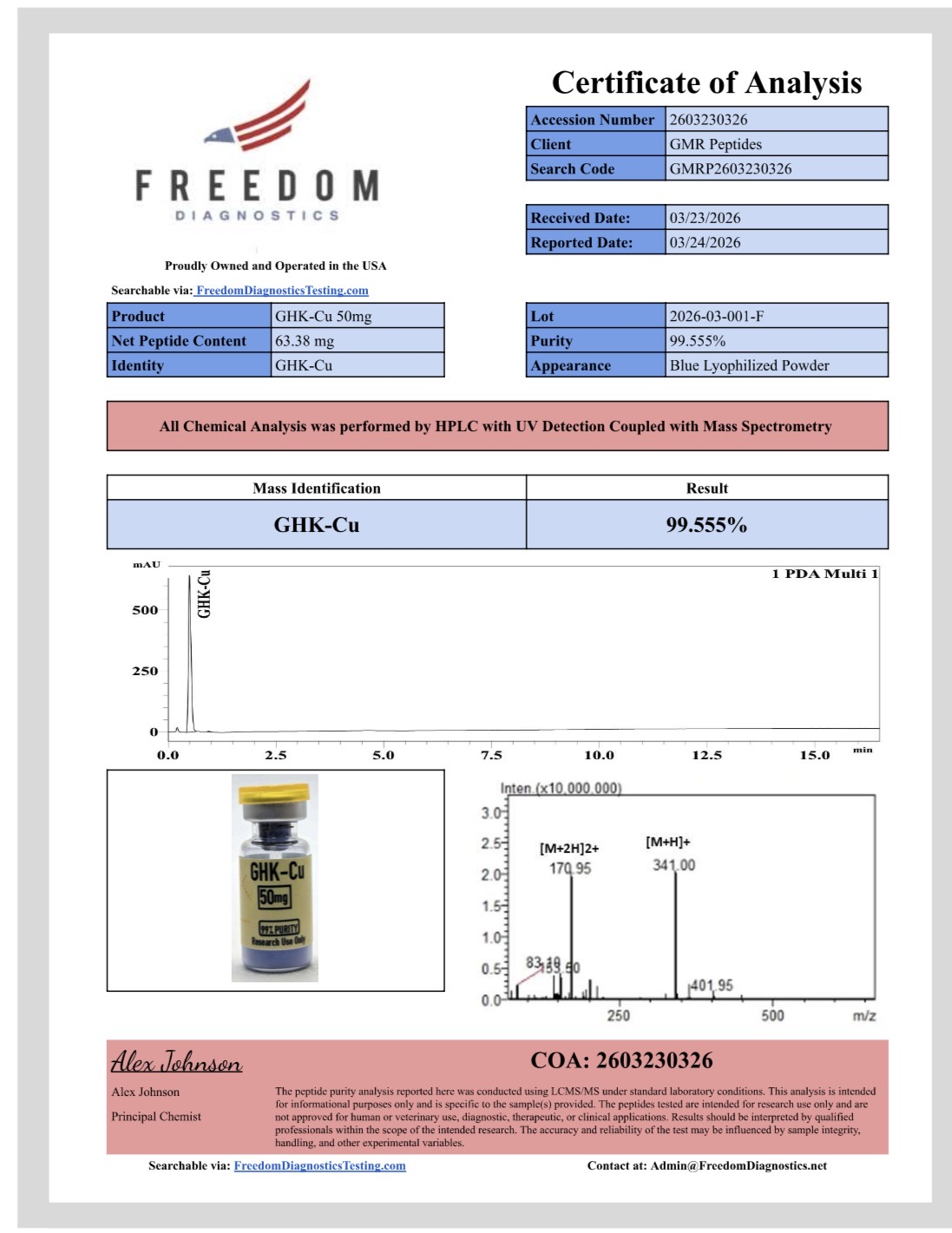
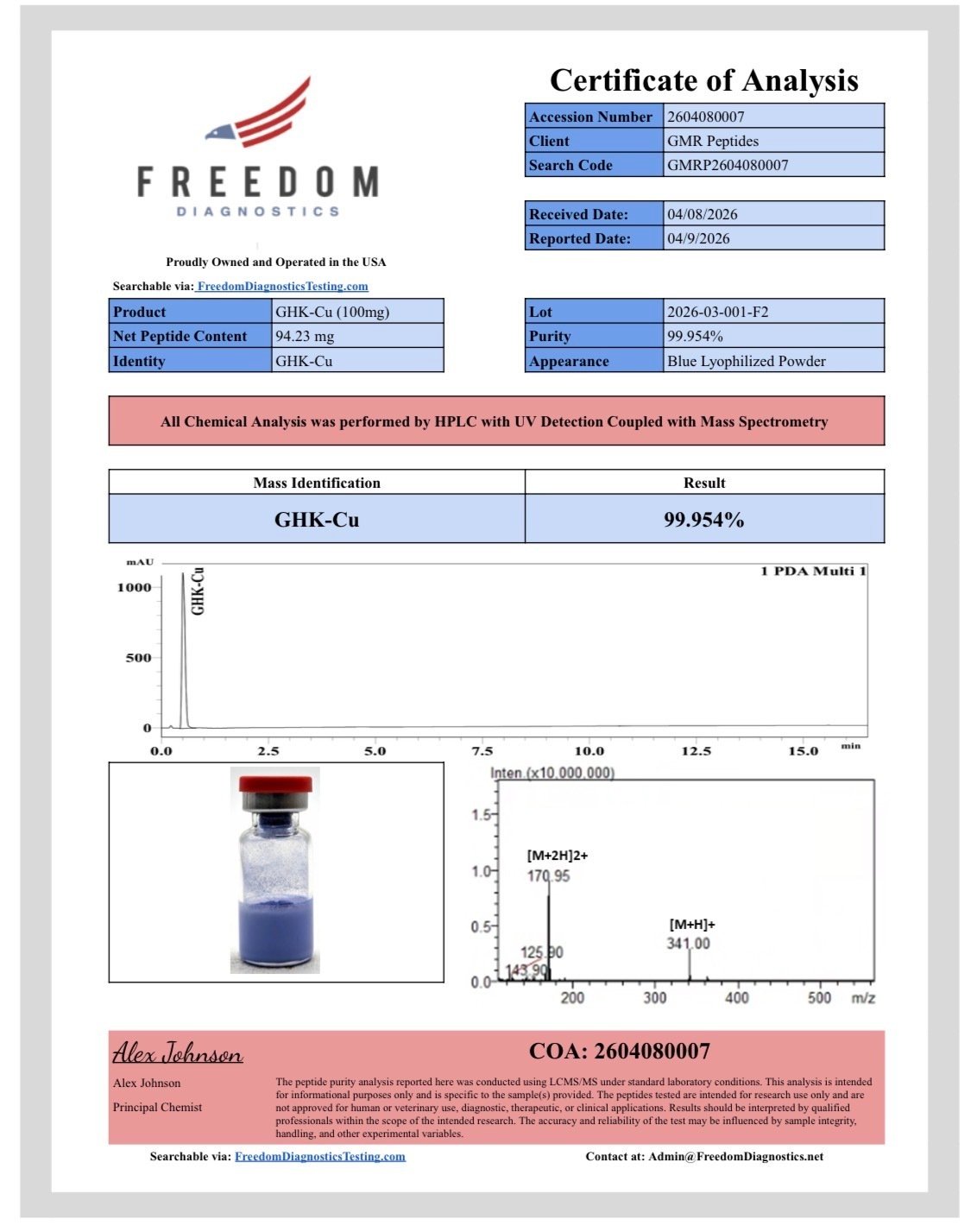
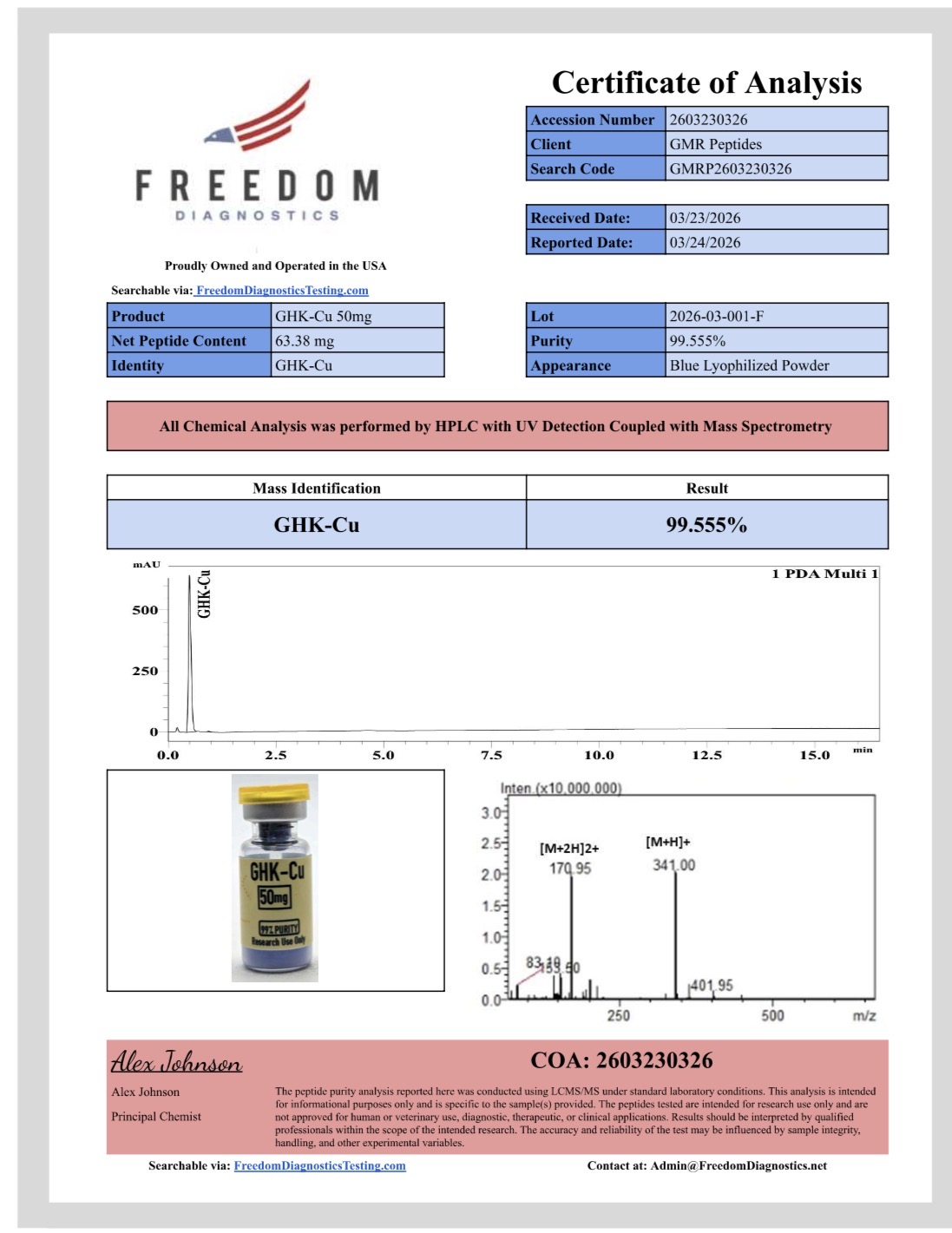
Certificate of Analysis and Batch Verification

🧪 Lab Verified

Each production lot is independently verified using HPLC and mass spectrometry to confirm
identity, purity, and structural consistency

GHK-Cu - 50mg Vial

Lot #2026-03-001-F

PASS
0%

Verified Purity

Labeled 50mg
Actual 63.38 mg
Tested 03/24/2026
Method HPLC with UV Detection coupled with Mass Spectrometry (LCMS/MS)
Lab Freedom Diagnostics
Status In Stock
Download Certificate

GHK-Cu - 100mg Vial

Lot #2026-03-001-F2

PASS
0%

Verified Purity

Labeled 100mg
Actual 94.23 mg
Tested 04/09/2026
Method HPLC with UV Detection coupled with Mass Spectrometry (LCMS/MS)
Lab Freedom Diagnostics
Status In Stock
Download Certificate

Third-Party Independent Verification — All GMR Peptides products are tested by accredited external laboratories using HPLC and Mass Spectrometry. We never self-certify. Results are published on every product page with no exceptions.

99%+

Batch Verified Purity

Validated via HPLC and Mass Spectrometry for structural consistency
STABLE

Lyophilization Stability

Controlled lyophilization ensures maximum material integrity during storageme
Lot-ID

Independent Confirmation

Every production batch undergoes independent analytical verification
PRO

Research Grade Handling

Supplied strictly for qualified professionals in laboratory environments

🧬 Mechanism of Action

Molecular Profile of GHK-Cu

GHK-Cu is a naturally occurring copper-binding tripeptide studied in laboratory environments for its interaction with extracellular matrix signaling pathways, copper transport activity, and peptide-mediated gene expression models.

GE
Primary Pathway

Molecular Profile

Extracellular Matrix Signaling

Evaluated in laboratory environments for interactions with signaling pathways and peptide-mediated gene expression models.

  • Analyzes extracellular matrix signaling pathways
  • Evaluates copper transport activity models
  • Investigates gene expression regulation frameworks
COL
Strongest Output

Structural Profile

Peptide Signaling Context

Frequently evaluated in experimental models designed to examine cellular communication and structural protein regulation mechanisms.

  • Examines cellular communication pathways
  • Analyzes structural protein regulation mechanisms
  • Evaluates trace-element peptide interactions
Cu2+
Supportive Pathway

Ion Binding Dynamics

Cellular Mineral Transport

The copper-binding component delivers bioavailable copper to research systems, activating internal enzymatic antioxidant models.

  • Delivers bioavailable copper to research systems
  • Activates enzymatic antioxidant model systems
  • Evaluates copper ion transport behavior

🔬 Key Research Finding

Unprecedented Genomic Influence

No other studied peptide approaches GHK-Cu’s ability to modulate the human genome. Research demonstrates influence over 31.2% of all human genes — affecting pathways from DNA repair and antioxidant defense to stem cell activation and anti-inflammatory response.

1,942

Genes Upregulated

762

Genes Downregulated

🧬 Mechanism of Action

Analytical Comparison With Peptides Related Copper

Within copper-binding peptide research, GHK-Cu is frequently evaluated alongside related
signaling peptides to investigate structural stability, copper coordination behavior, and extracellular
matrix interaction patterns under controlled experimental conditions

Hair Research

Follicle Restoration

Controlled studies report measurable improvements in hair follicle size, growth rate, and active growth phase duration.

Follicle size increase
Growth rate improvement
Anagen phase extension
Wound Healing

Accelerated Tissue Repair

Multiple repair mechanisms activate simultaneously — making GHK-Cu one of the more comprehensively studied wound-healing compounds.

Fibroblast migration ↑ 70% faster
Blood vessel formation ↑ Enhanced
Collage deposition ↑ Increased
Inflammatory response ↓ Reduced
Gene Modulation

Epigenetic Reprogramming

GHK-Cu functions as a cellular reprogrammer — shifting gene expression away from destructive aging patterns toward regenerative activity.

4,000+
Antioxidant Defense

Cellular Protection System

Activates the body's internal antioxidant machinery — particularly the SOD enzyme system responsible for neutralizing free radicals.

SOD enzyme activity
Lipid peroxidation reduction
Catalase expression

✨ Extended Research

Areas of Laboratory Investigation

Researchers commonly examine GHK-Cu in controlled experimental systems involving peptide
signaling pathways, copper ion transport behavior, extracellular matrix organization models, and
gene expression regulation frameworks.

Research Context

Peptide Signaling Pathways

Laboratory models evaluate GHK-Cu in experimental systems involving cellular communication mechanisms.

Signal Transduction Affinity
Coordination Stability
Structural Research

Matrix Organization Models

Cellular Communication Verified Pathway
Structural Coordination High Stability
Experimental Consistency Lot-Verified
Genomic Investigation

Gene Expression Regulation

Analysis of peptide-mediated gene expression regulation frameworks[cite: 22, 27].

1,942+
Upregulated Genes Observed
Element Transport

Copper Ion Behavior

Bioavailability Index
Enzymatic Interaction Model

⚠️ Safety Data

Research Handling Guidelines

This material is supplied exclusively for laboratory research use. Handling should be performed by
qualified professionals using appropriate experimental procedures and analytical documentation
review prior to use.

Research Handling Guidelines

  • 🔒 For laboratory research use only.
  • 🔒 Handling by qualified professionals only.
  • 🔒 Not for human or veterinary applications.
  • 🔒 Strictly for in-vitro and experimental models.
Material must be handled according to established laboratory safety protocols and analytical documentation review prior to use.

Material Stability Data

  • Lyophilized for long-term structural integrity.
  • HPLC verified batch purity standards.
  • Controlled environment storage recommended.
  • Independent analytical lot verification.
Batch verification confirms identity and structural consistency across all supplied research compounds.

🧪 Technical Specifications

Compound Information

Full molecular and technical reference data for GHK-Cu.

🔬 Molecular Profile
Compound Identification Copper-binding Tripeptide
CAS Number 89030-95-5
Molecular Weight 340.38 g/mol (free)
Sequence Architecture Gly-His-Lys (Cu2+)
Molecular Formula C14H24N6O4Cu
Verification Method HPLC / Mass Spectrometry
Verified research compound interaction with extracellular matrix signaling pathways and copper transport activity.
🧊 Research Handling Guidelines

This material is supplied exclusively for laboratory research use by qualified professionals.

❄️

Lyophilized Stability (-20°C)

Analytical consistency for 24 months

🧪

Reconstituted State (2-8°C)

Maintain structural integrity for 30 days

⏱️

Ambient Experimental Use

Complete observation within 24 hours

🔵 Observation Note: Reconstituted blue coloration signifies active coordination behavior. Colorless samples suggest loss of coordination integrity.
📋 Investigation Timeline
1973 Initial isolation of copper-binding tripeptide from laboratory plasma models.
1980s Established baseline safety profile and molecular coordination analysis.
2000s Expansion of research models into cellular communication and signaling.
2018+ Landmark research observing 4,000+ peptide-mediated gene expression modulations.
Lot-ID Verified Batch
HPLC Verified Purity

❓ Common Questions

Frequently Asked
Questions

GHK-Cu is a naturally occurring copper-tripeptide (glycyl-L-histidyl-L-lysine bound to copper) first identified in human plasma in 1973. It is naturally present in human blood, saliva, and urine. The peptide is released from damaged tissue as part of the body's repair signaling cascade. Circulating levels peak in early adulthood and decline significantly with age — dropping from roughly 200 ng/mL at age 20 to approximately 80 ng/mL by age 60.

📚 Research Bibliography

Sources & References

All clinical data and research findings cited on this page are sourced from peer-
reviewed journals and official publications.

International Journal of Molecular Sciences

Regenerative and Protective Actions of the GHK-Cu Peptide in the Light of the New Gene Data

Pickart L, Margolina A
2018 PMID: 29986520
BioMed Research International

GHK Peptide as a Natural Regulator of Multiple Cellular Pathways in Skin Repair and Regeneration

Pickart L, Vasquez-Soltero JM, Margolina A
2015 PMID: 26236730
Journal of Cosmetic Science

A 12-week, double-blind, placebo-controlled study evaluating GHK-Cu facial cream efficacy

Finkley et al.
2005 PMID: 15841272
Journal of Cosmetic Laser Therapy

Stimulation of collagen production by copper-peptide complex

Appa Y et al.
2007 PMID: 17565151
Journal of Aging Science and Clinical Practice

Effects of GHK-Cu in nano-carriers on MMP expression and facial wrinkle parameters

Gorouhi F, Maibach HI
2009 PMID: 19134125
Archives of Facial Plastic Surgery

Effects of Topical Copper Tripeptide Complex on CO2 Laser-Resurfaced Skin

Miller TR et al.
2006 DOI: 10.1001/archfaci.8.4.252
Various Sources (Dermatology Research)

GHK-Cu effects on hair follicle growth and size

Multiple researchers
2020 PMID: 11210141
Journal of Cosmetic Dermatology

Anti-inflammatory effects of GHK-Cu

Campbell JD et al.
2012 PMID: 22670613

⚠️ Important Research Notice

This product is sold exclusively for in vitro research and educational purposes. It is not intended for human or veterinary use, and is not intended to diagnose, treat, cure, or prevent any medical condition or disease. All clinical trial data, research findings, and scientific information presented on this page are sourced from peer-reviewed academic publications. This content is provided for educational reference only and does not constitute medical advice, product claims, or treatment recommendations. By purchasing this product, the buyer confirms they are a qualified researcher and will use it strictly in accordance with all applicable federal, state, and local laws and regulations. GMR Peptides assumes no liability for any misuse of this product outside of a research context.

Website Exclusive

Welcome, researcher

Enter your email to unlock 20% off your first research supply order.

Please enter a valid email address.
No spam, unsubscribe anytime.
Your 20% discount is unlocked
PEP20

Shop Now With 20% Off
Apply as Affiliate