variation
gallery

🔬 Research Use Only

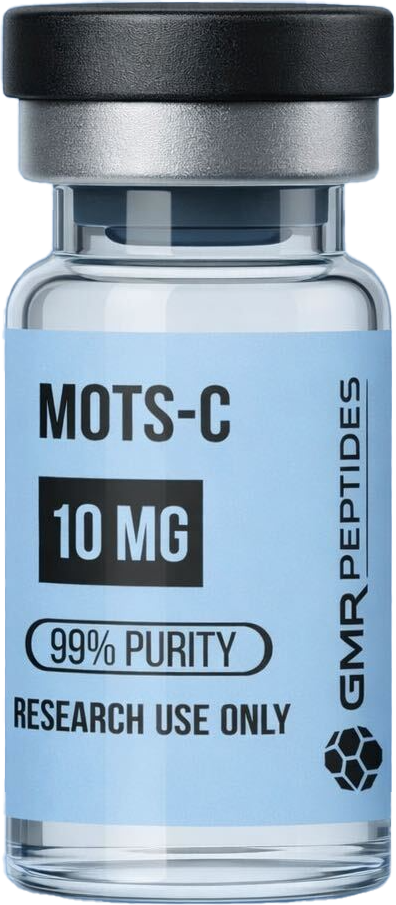
MOTS-C Research Peptide

Longevity Research · Metabolic Research

MOTS-c is a potent mitochondrial-derived peptide (MDP) consisting of 16 amino acids and encoded by the mitochondrial 12S rRNA gene. As a pivotal regulator of cellular metabolism, MOTS-c has gained increasing interest in scientific research for its profound role in mitochondrial signaling and stress response pathways. Recent studies have explored the functions of the MOTS-c peptide in regulating insulin sensitivity, metabolic homeostasis, and cellular adaptation under bioenergetic stress.

Select Dosage

Bundle & Save

1 bottle

1 bottle

2 bottle

5% OFF
2 bottle

3 bottle

7.5% OFF
3 bottle
Bundle & Save

1 bottle

$44.99

2 bottle

Save 5%

3 bottle

Save 7.5%
$44.99

19 in stock

. ships today if ordered before 3pm ET

per 10mg vial

SSL 256-bit

Secure Checkout

Free shipping

On orders over $200

60-day returns

Money-back guarantee

🚚 Get 2 day shipping when you spend $250 or More

🚚 Free shipping over $200

🔄 60-day money back

🔒 SSL Secure

📦 Discreet packaging

We Accept

variation
gallery

🔬 Research Use Only

MOTS-C Research Peptide

Longevity Research · Metabolic Research

MOTS-c is a potent mitochondrial-derived peptide (MDP) consisting of 16 amino acids and encoded by the mitochondrial 12S rRNA gene. As a pivotal regulator of cellular metabolism, MOTS-c has gained increasing interest in scientific research for its profound role in mitochondrial signaling and stress response pathways. Recent studies have explored the functions of the MOTS-c peptide in regulating insulin sensitivity, metabolic homeostasis, and cellular adaptation under bioenergetic stress.

Select Dosage

Bundle & Save

1 bottle

1 bottle

2 bottle

5% OFF
2 bottle

3 bottle

7.5% OFF
3 bottle
$44.99

🚚 Get 2 day shipping when you spend $250 or More

🚚 Free shipping over $200

🔄 60-day money back

🔒 SSL Secure

📦 Discreet packaging

We Accept

99%+ Purity Guaranteed

Every batch verified by accredited US labs

Shipment Protection

Every order fully covered

60-Day Money Back

No questions asked

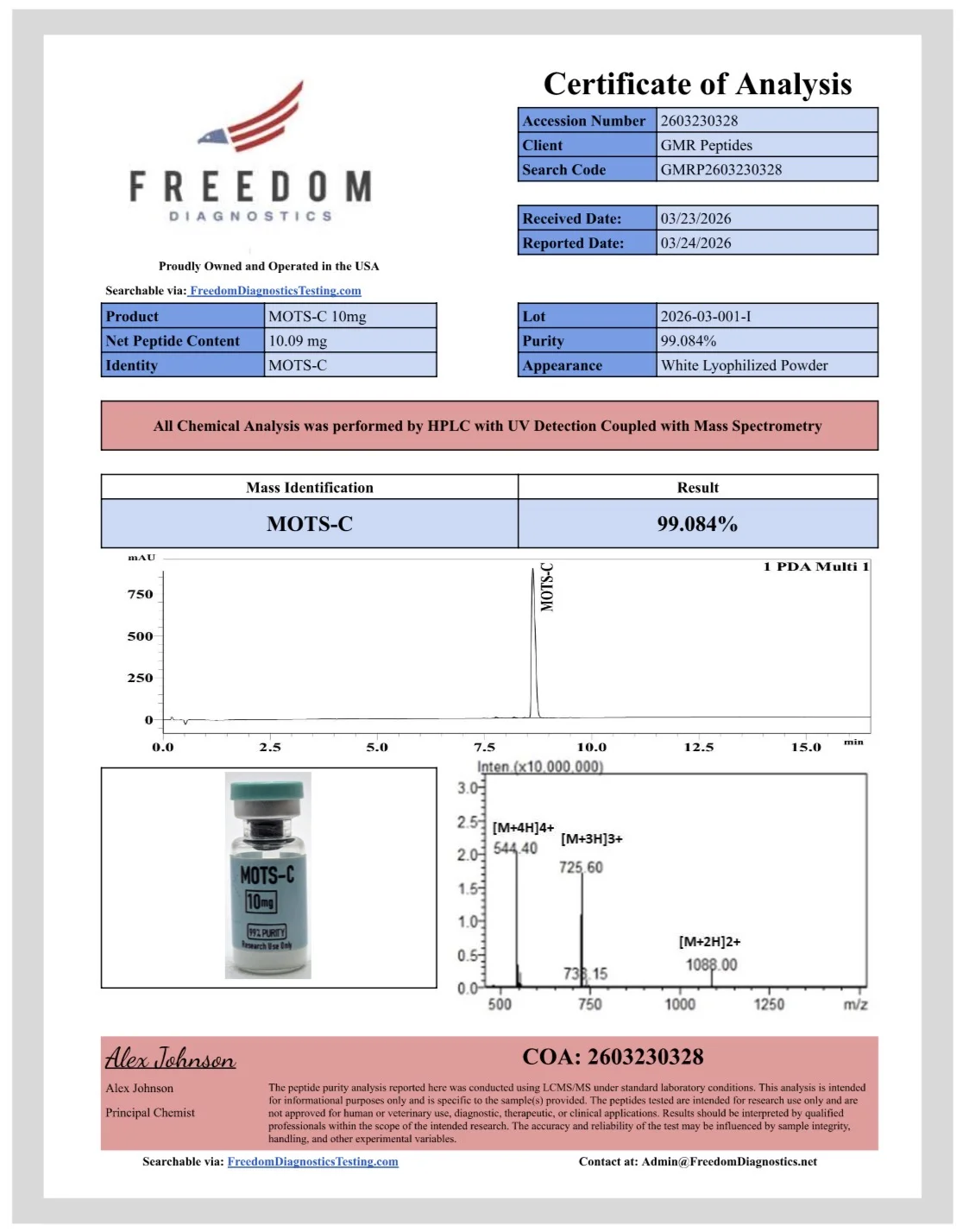
Certificate of Analysis and Peptide Purity Verification

🧪 Lab Verified

This section should emphasize lot-specific peptide purity verification, analytical transparency, and laboratory
documentation. Present the COA as supporting material for research sourcing review, including lot
traceability, measured content, analytical method, test date, and release status.

MOTS-C 10mg - 10mg Vial

Lot #2026-03-001-I

PASS
0%

Verified Purity

Labeled 10mg
Actual 10.09 mg
Tested 03/24/2026
Method HPLC with UV Detection coupled with Mass Spectrometry (LCMS/MS)
Lab Freedom Diagnostics
Status
Download Certificate

Running Time

Exercise-associated endurance observation in preclinical models
6.4%

Lifespan Increase

Longevity-pathway observation in preclinical lifespan evaluation
11.9×

Muscle Expression

Post-activity expression signal observation in cited
model data
AMPK

Activation

AMPK pathway signaling behavior observation
16aa

Peptide Length

Mitochondrial-derived peptide structural profile

Mechanistic Signaling Overview

A technical analysis of MOTS-c mitochondrial-derived peptide signaling dynamics, focused on observed receptor interaction activity and intracellular metabolic adaptation pathways in laboratory models.

RESEARCH CONTEXT

Mitochondrial-Derived Signaling

MOTS-c is a 16-amino acid mitochondrial-derived peptide evaluated for exercise-associated signaling mimicry in laboratory settings. Research models explore its relationship with AMPK-linked pathway behavior, nutrient-sensing response patterns, and cellular adaptation signals under controlled experimental conditions.

AMPK Primary

AMPK Signaling Pathway

Metabolic Pathway Observation

  • Glucose uptake signaling
  • Fatty acid oxidation behavior
  • Insulin pathway interaction
Nuclear Secondary

Nuclear Translocation

Gene Regulatory Response

  • Stress response signaling
  • Metabolic adaptation markers
  • Cellular resilience studies
SIRT1 Supportive

NAD+/SIRT1 Interaction

Sirtuin-Associated Signaling

  • NAD+ pathway observations
  • SIRT1 expression signals
  • Mitochondrial signaling context
↗ Source: Lee et al., Cell Metabolism 2015
PATHWAY ANALYSIS

Why MOTS-C Is Studied in Laboratory Models

Researchers evaluate MOTS-c for peptide signaling dynamics related to metabolic adaptation, cellular stress signaling, and receptor interaction activity in preclinical research.

Exercise-associated signal: Published models have reported MOTS-c expression signal observations in skeletal muscle and plasma post-activity, demonstrating its role in metabolic signaling.
Muscle Expression Signal ↑ 11.9×
Plasma Signaling Observation ↑ 1.6×
Age-associated signal shift ↓ ~21%
Diet-associated measurement ↓ ~16%
PRECLINICAL OBSERVATION

Age-Related Signaling Observations in Experimental Models

Some published models have examined age-associated pathway behavior, mitochondrial signaling changes, and laboratory model evaluation of metabolic adaptation markers.

Longevity-pathway observation: Preclinical models treated with MOTS-c starting at 23.5 months showed a 6.4% longevity-pathway observation in median lifespan evaluation.

Experimental Signal Observation Summary

A comprehensive review of observed measurement changes and pathway-level findings across published preclinical literature and exploratory translational research datasets.

📋 Preclinical Observation Summary
Endurance Signal Observation in Aged Models

Exercise-Associated Endurance Observation

MOTS-c treated model +200%
Control model Baseline
Key observation: Published preclinical models have reported exercise-associated endurance signal observations in aged mice, alongside evaluation of metabolic flexibility markers and mitochondrial pathway behavior.
📈 Key Experimental Observation Areas

Pathway Activity Prevalence

Observed signaling behavior in selected preclinical datasets

100% of subjects
Diet-associated regulation signal High-fat diet model group
100% of subjects
Age-associated insulin signaling Middle-aged research models
79% of subjects
Survival-associated model outcome Preclinical infection model study
💡 Research context: Most data originates from preclinical laboratory model evaluation. The analog CB4211 has completed Phase 1a for safety assessment in research settings.
⚖️ Metabolic Signaling Observation Snapshot

Comparative Pathway Observations

Insulin signaling restoration (aged model) 100% OBSERVED
Body-weight-associated measurement shift 85% RELATIVE TO CONTROL
Fat-oxidation-related pathway observation 140% SIGNAL INCREASE
⚠️ Note: These observations are derived from preclinical mouse studies. Human research context is limited to safety and tolerability assessment of the analog CB4211.

Research Applications & Experimental Context

An exploration of secondary signaling observations and exploratory measurement outcomes across diverse laboratory models, ranging from longevity-pathway analysis to cardiovascular and immune signaling research.

17%
LONGEVITY PATHWAY

Observed lifespan measurement in aged laboratory models

↗ Reynolds et al., 2021
↓55%
VASCULAR SIGNALING

Observed reduction in vascular signaling markers

↗ Wei et al., 2020
79%
IMMUNE RESPONSE

Preclinical survival-associated model outcome

↗ ADDF Report
↓33%
CB4211 ANALOG

Reported measurement shift in research datasets

↗ CohBar Data
🔥 METABOLIC SIGNALING

Metabolic Signaling Stability

Research evaluates MOTS-c for its potential to influence metabolic adaptation signals and restore insulin signaling pathway sensitivity in controlled experimental models.

Glucose uptake signal ↑ Observed
Fatty acid oxidation pathway ↑ Active
Insulin signaling baseline ↑ Measured
High-fat diet adaptation ↓ Evaluated
🔬 Research finding: Clinical datasets reported that plasma MOTS-c levels were inversely correlated with BMI and insulin resistance markers in specific study cohorts.
↗ Lee et al., Cell Metab 2015
🦴 SKELETAL SIGNALING

Bone Homeostasis Research

Laboratory models analyze MOTS-c for its impact on bone density signaling and its role in promoting bone-repair-associated gene expression.

Bone signaling restoration +75%
Osteoclast activity signal ↓ Evaluated
Osteogenesis marker expression +70%
↗ Ming et al., 2016
💗 CARDIOVASCULAR

Vascular Signaling Dynamics

MOTS-c levels were observed to correlate with endothelial function markers in research, with treatment datasets showing measurement shifts in vascular signaling.

55%
Observed shift in vascular signaling markers
💡 Clinical correlation: Research cohorts with endothelial dysfunction markers showed significantly lower plasma MOTS-c levels compared to control datasets.
↗ Wei et al., Cardiorenal Med 2020
🛡️ IMMUNE SIGNALING

Immune Response Exploration

Preclinical models evaluate MOTS-c for its potential to influence macrophage bactericidal capacity and inflammatory signaling pathway modulation.

Model survival measurement Baseline → Reported
Pathogen-associated response ↑ Observed
Bacterial load measurement ↓ Evaluated
Cytokine signaling markers ↓ Modulated
↗ ADDF Cognitive Vitality Report

Molecular Profile & Technical Specifications

A detailed breakdown of the MOTS-c peptide sequence, molecular architecture, and standardized laboratory handling protocols required for experimental consistency and stability.

🔬 MOLECULAR ARCHITECTURE

Sequence & Identity

Peptide Class Mitochondrial-derived (MDP)
Amino Acid Count 16 Residues
Primary Sequence MRWQEMGYIFYPRKLR
Molecular Mass 2,174.6 g/mol
Empirical Formula C101H152N28O22S2
Genetic Origin 12S rRNA (mtDNA)
↗ Source: Cell Metabolism (2015)
🧊 STABILITY & HANDLING

Laboratory Storage

Thermal Sensitivity Lyophilized State Recommended Cold-Chain Required
❄️
Lyophilized Format
-20°C ・ Long-term stability
💉
Reconstituted Solution
2-8°C ・ Immediate use
🧪
Ambient Sensitivity
Significant degradation in 2-3h
📜 REGULATORY STATUS

Development Timeline

● Laboratory Discovery (2015) ● Analog CB4211 Phase 1 ● Research Use Only (RUO)
Primary PI Pinchas Cohen, USC
WADA Status S1.2 (Prohibited)
Clinical Pipeline Analog Trial for NAFLD
Usage Designation Preclinical Research
↗ View Trial Pipeline

❓ Common Questions

Frequently Asked
Questions

MOTS-C is described in peptide literature as a mitochondrial-derived peptide encoded within mitochondrial
12S rRNA. On this page, it should be presented as a research-use-only compound supplied for laboratory
peptide signaling studies and pathway-level experimental evaluation.

📚 Research Bibliography

Sources & References

All clinical data and research findings cited on this page are sourced from peer-
reviewed journals and official publications.

Cell Metabolism

The Mitochondrial-Derived Peptide MOTS-c Promotes Metabolic Homeostasis and Reduces Obesity and Insulin Resistance

Lee C, Zeng J, Drew BG et al.
2015 PMID: 25738459
Nature Communications

MOTS-c is an exercise-induced mitochondrial-encoded regulator of age-dependent physical decline and muscle homeostasis.

Reynolds JC, Lai RW, Woodhead JST et..
2021 PMID: 10.1038
Alzheimer's Drug Discovery Foundation

MOTS-c Cognitive Vitality Report

ADDF Aging and Alzheimer's...
2021
Aging Cell

The mitochondrial-derived peptide MOTS-c: a player in exceptional?

Fuku N, Pareja-Galeano H, Zempo H et
2015 PMID: 26289118
Physiol Rep

The mitochondrial-derived peptide MOTS-c and its role in metabolic regulation

Kim S-J, Miller B, Mehta HH et al.
2019 PMID: 31293078
Biochemical and Biophysical Research Communications

Mitochondria related peptide MOTS-c suppresses ovariectomy-induced bone loss via AMPK activation

Ming W, Lu G, Xin S et al.
2016
Pediatric Diabetes

Circulating MOTS-c levels are decreased in obese male children and adolescents and associated with...

Du C, Zhang C, Wu W et al.
2018
ClinicalTrials.gov

Study of CB4211 in Patients With Nonalcoholic Fatty Liver Disease (NAFLD) and Obesity

CohBar, Inc.
2019

⚠️ Important Research Notice

This product is sold exclusively for in vitro research and educational purposes. It is not intended for human or veterinary use, and is not intended to diagnose, treat, cure, or prevent any medical condition or disease. All clinical trial data, research findings, and scientific information presented on this page are sourced from peer-reviewed academic publications. This content is provided for educational reference only and does not constitute medical advice, product claims, or treatment recommendations. By purchasing this product, the buyer confirms they are a qualified researcher and will use it strictly in accordance with all applicable federal, state, and local laws and regulations. GMR Peptides assumes no liability for any misuse of this product outside of a research context.

Website Exclusive

Welcome, researcher

Enter your email to unlock 20% off your first research supply order.

Please enter a valid email address.
No spam, unsubscribe anytime.
Your 20% discount is unlocked
PEP20

Shop Now With 20% Off
Apply as Affiliate